
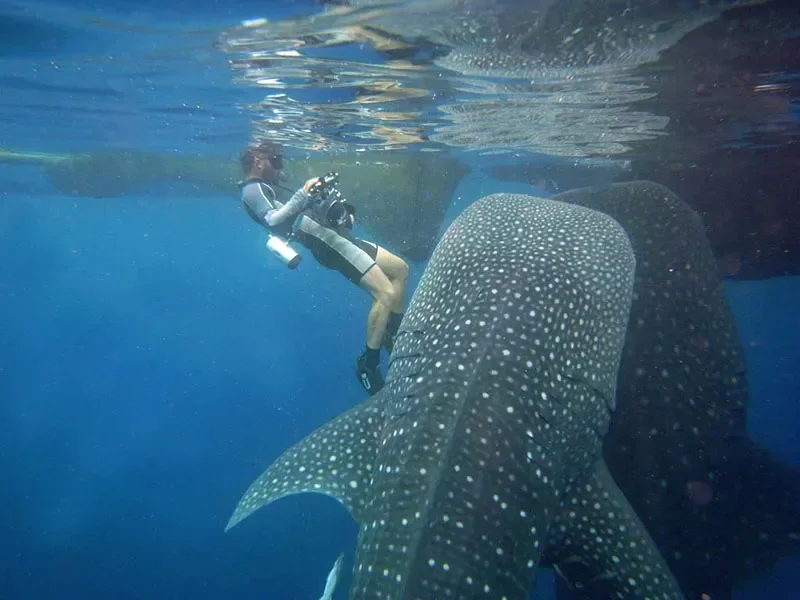
The most effective whale shark photography tips for Cenderawasih Bay come down to four decisions: shoot wide behind a dome port, expose for the bright surface rather than the shaded water column, keep strobes powered down and angled outward to control bagan backscatter, and frame from a respectful distance of three metres or more. Get those four right and the Kwatisore platforms will hand you vertical feeding shots that are close to impossible to capture anywhere else.
Kwatisore sits inside Teluk Cenderawasih National Park, Indonesia’s largest marine national park, and as of 2026 the whale shark aggregation around its bagans — the lifted fishing platforms where sharks come to sip baitfish from the nets — remains active nearly year-round, with access running through Nabire. This article is a pure technique guide: camera settings, port choice, lighting strategy, and ethical framing. If you want dive-site sequencing and route planning for a full photography itinerary, that is a different job — and one our dedicated Cenderawasih Bay photography expedition is built around.
Why Is Shooting at a Bagan Different from Open-Water Whale Shark Photography?
Most whale shark photography tips assume a cruising animal in blue water — Ningaloo-style passes where the shark swims a straight line and you fin alongside it. Kwatisore breaks those assumptions in three ways, and your technique has to change with them.
- The sharks feed vertically. At the bagans, whale sharks routinely hang tail-down and suction-feed at the nets, mouths at the surface. The classic side profile becomes the exception; the signature image here is a vertical animal shot from below or head-on at the net.
- The water is full of particles. Bait scatter, fish scales, and plankton drift constantly under a working platform. That soup is exactly why the sharks are there, and it is also the single biggest image-killer if you light it badly.
- Half your scene is shade. The platform casts a hard-edged shadow. Sharks slide between dappled sunlight and deep shade in seconds, which punishes fixed manual exposure and rewards photographers who ride their settings.
Most encounters at Kwatisore involve juvenile whale sharks, commonly in the four-to-six-metre range — still far bigger than your frame at close range, which is why lens and port choice matter more here than sensor size.
Whale Shark Photography Tips: Camera Settings That Work Under a Platform
Start from this baseline and adjust to the day: shutter 1/250s, aperture f/8, auto ISO capped at 1600, continuous autofocus with a wide focus area, and burst mode on. Then refine per shot type.
Settings for the vertical feeding shot
The mistake most photographers make on the vertical shot is exposing for the shark. Expose for the surface instead. Your background is the bright, textured underside of the sea surface with the bagan’s silhouette breaking it — if you meter on the shaded flank of the animal, the surface blows out into a white sheet and the platform disappears. Dial in negative exposure compensation of around one stop (or in manual, set your exposure off the surface and let the shark sit dark), then lift the shadows in post. Modern sensors recover a dark whale shark far better than they recover a burned-out sunball.
Shutter speed matters more than usual because you are often shooting upward while finning to hold position, and the shark’s head moves in short pulses as it suction-feeds. Below 1/200s you will see soft gill detail in otherwise sharp frames. If light allows, 1/320s is safer.
A quick reference by shot type
| Shot type | Shutter | Aperture | Approach |
|---|---|---|---|
| Vertical feeding portrait | 1/250–1/320s | f/8 | Expose for the surface, shoot slightly upward, keep the net edge in frame for context |
| Silhouette against the sun | 1/500s+ | f/11–f/16 | Strobes off, position directly below, let the shark go fully black |
| Split shot at the platform | 1/320s | f/11+ | Large dome only, focus on the underwater half, overcast mornings are easiest |
| Swimmer-for-scale frame | 1/250s | f/8 | Brief your buddy to hold still at distance; the shark provides the motion |
The swimmer-for-scale frame is where a capable in-water team earns its keep — a freediver hanging motionless mid-column reads far cleaner than a snorkeler kicking at the surface. It is one of the reasons photographers gravitate to our Cenderawasih Bay freedive expedition format: breath-hold models produce no bubbles and hold composed body lines.
Dome Port or Flat Port for Cenderawasih Bay?
Dome, and it is not close. A flat port magnifies the scene by roughly a quarter and narrows your effective field of view — fatal when a five-metre animal is filling your frame from two metres away. A dome port preserves the true angle of your wide lens, focuses close enough to work at the intimate distances the bagan allows, and is the only way to attempt split shots of the platform above and the shark below.
Practical port notes for this specific site:
- Wide is non-negotiable. A rectilinear ultra-wide or a fisheye behind a dome are the two standard choices. Fisheye gets you closer — less water, less particulate, better colour — but bends the platform’s poles; rectilinear keeps the bagan’s architecture honest.
- Bigger domes help splits, smaller domes travel. Given the small-plane hop through Nabire, many shooters compromise on a mid-size dome. It still splits acceptably in calm dawn conditions.
- Compact and action cameras work here. The sharks come close enough that a compact with a wet wide-angle lens, or an action camera on ambient light, produces genuinely publishable frames. Kwatisore is one of the most forgiving big-animal sites in Indonesia for modest rigs.
Ambient Light or Strobes Under the Platform?
Ambient first, strobes as a precision tool. Early light at the bagans is soft and directional, and by mid-morning the sun overhead pushes usable light into the top few metres where the action happens. A large fraction of the best frames ever shot at Kwatisore are pure ambient with a manual white balance set at depth or a shallow magenta-corrected profile in post.
When you do fire strobes, the enemy is bagan backscatter — that bait-and-scale soup lighting up like snow between your dome and the shark. Control it the standard way, but more aggressively than you would on a reef:
- Pull strobes wide and slightly behind the port plane, angled outward so only the edge of each beam feathers across the subject. You are lighting the shark, not the water column.
- Power down. Quarter power is often enough at these distances; you want fill on the white spot pattern, not full illumination.
- Get closer instead of brighter. Every metre of water you remove takes its suspended particles out of the light path with it.
- Know when to switch them off. The moment you turn to a silhouette or a sun-behind-shark composition, strobes only add snow. Kill them and shoot fast.
How Do You Frame Ethically Without Losing the Shot?
Teluk Cenderawasih is a protected national park and the interaction rules exist so this aggregation stays photographable for decades. The good news: ethical positioning and strong composition point the same direction. Our in-water briefing standard is simple — never touch, never ride, never block the animal’s line to the net, and hold roughly three metres from the body with extra margin from the tail. A wide lens at three metres still renders a juvenile whale shark enormous in frame; crowding closer mostly adds distortion and stress, not impact.
Work the edges of the scene rather than the feeding lane. Shooting from the side of the net at a slight upward angle gives you the mouth, the eye, and the platform in one composition — and keeps you out of the path of a shark that decides to surface. Watch swimmer traffic too: on busy platforms the difference between a clean frame and a cluttered one is simply waiting thirty seconds for other guests to drift out of the background. Small groups fix this problem at the source, which is why our swim with whale sharks program caps in-water numbers per platform session.
Putting It Together at Kwatisore
The bagans reward photographers who arrive with a plan: dome port mounted, baseline settings dialled the night before, a shot list ordered from ambient silhouettes at first light to strobe-fill portraits once the sun climbs. These whale shark photography tips will carry you a long way on any operator’s boat — but the difference between a good morning and a career image is usually time in the water, and that is a logistics question as much as a technique question.
If you want platform sessions timed for light, a skipper who understands photography, and in-water guides who can model for scale, talk to our trip desk. Part of Juara Holding Group — operating from Bali across Indonesia since 2015 — we build Cenderawasih itineraries around the shot list, not the other way around. Message us on WhatsApp at +62 811-3941-4563 or email [email protected] with your camera setup and travel window, and we will map the rest.