Cenderawasih Bay bagans are the floating lift-net fishing platforms anchored off Kwatisore, West Papua — and they are the single biggest reason whale sharks can be found here almost every month of the year. Each night the platforms’ lamps pull in dense schools of small baitfish, and the bay’s whale sharks have learned to feed directly at the nets, turning a working fishery into the most predictable whale shark encounter inside Indonesia’s largest marine national park. Understanding how the bagans work, who runs them, and how to behave around them is the key to visiting this place well.
What Exactly Is a Bagan?
A bagan is a traditional Indonesian lift-net fishing platform: a square frame of timber and bamboo, floated or anchored offshore, with a large net suspended beneath it on ropes and winches. After dark, the crew switches on bright lamps mounted over the water. The light draws in schools of small silvery baitfish — known locally around Kwatisore as ikan puri — which gather in the glowing column beneath the platform. Before dawn, the crew winches the net up through the school and hauls the catch aboard.
The technique did not originate in Papua. Many of the crews working the Kwatisore coast trace their lift-net methods to the fishing traditions of South Sulawesi, and bagans like these operate all over the Indonesian archipelago. What makes the platforms in Teluk Cenderawasih different is not the fishing — it is who shows up to share the catch.
Why Do Whale Sharks Stay at Cenderawasih Bay Bagans Year-Round?
At most whale shark destinations, the animals arrive for a seasonal food event — a plankton bloom, a coral spawn, a baitfish run — and leave when it ends. Kwatisore is different because the food source never really stops. The bagans fish most nights of the year, which means there is a small, reliable concentration of baitfish in the same patch of water week after week. The bay’s whale sharks have learned this, and individual animals return to the platforms again and again.
Several conditions combine to anchor the aggregation:
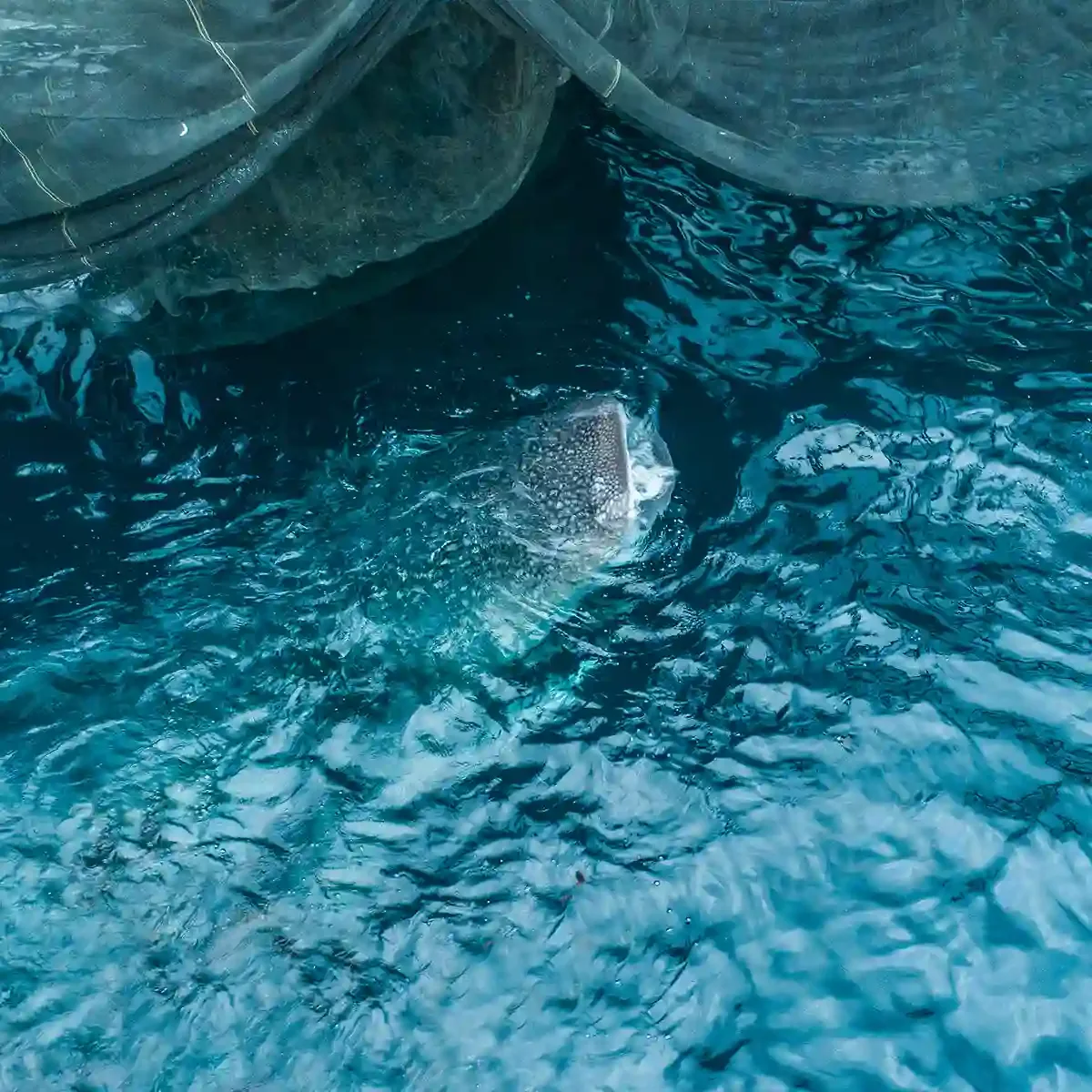
- A standing food supply. Sharks hang below and beside the nets, using suction feeding — often in a near-vertical, tail-down posture — to pull loose baitfish through the mesh or take fish the crews toss into the water.
- Deep, sheltered water close to shore. The Kwatisore coastline drops away quickly, so large pelagic animals can feed at the platforms without leaving deep water, inside a bay that stays calm for much of the year.
- Protection. The platforms sit inside Teluk Cenderawasih National Park, which as of 2026 remains Indonesia’s largest marine national park, covering more than 1.4 million hectares of sea, islands, and coastline where the sharks are a protected species.
- Culture. Local crews call the whale shark gurano bintang — the star shark — and many fishermen have long regarded its presence at the nets as good fortune rather than a nuisance. Sharks are tolerated, fed by hand, and never driven off.
Ongoing photo-identification work in the bay supports what the fishermen already knew: many of the same individuals — mostly young male sharks — are resighted at the platforms across months and years. That residency is why a well-planned trip here does not gamble on a season the way most whale shark travel does. Our Kwatisore whale shark trips are built entirely around this behavior.
How a Morning at the Bagans Actually Unfolds
The encounter follows the fishery’s rhythm, not a tour schedule. Crews fish through the night and lift the nets around first light, so the best window at the platforms is early morning, when baitfish are still concentrated and the sharks are actively feeding. A typical sequence looks like this:
- Your boat approaches a working platform slowly and your guide checks in with the crew — every visit happens with the fishermen’s permission.
- The crew confirms whether sharks are present; on many mornings one look over the rail answers the question.
- Guests enter the water in small groups, on snorkel or scuba, keeping to the edge of the feeding zone rather than the middle of it.
- The crew may release handfuls of baitfish, which holds the sharks near the platform in clear view.
- By mid-morning the activity tapers off as the catch is stowed, and boats move off so the crew can rest.
Because the platforms shift position and fishing effort varies night to night, sightings are never a contractual guarantee — but the pattern at the Cenderawasih Bay bagans is as consistent as whale shark watching gets anywhere, and multi-day itineraries give you several mornings to work with.
Fisher Partnerships: Who Benefits When You Visit?
Every respectful visit to the Cenderawasih Bay bagans runs on a relationship. The platforms are private working fisheries, not tourist infrastructure, and the crews are under no obligation to host swimmers. Reputable operators maintain standing arrangements with the bagan owners and crews: visits are agreed in advance or on approach, crews are compensated for hosting guests and for the baitfish used during encounters, and boats rotate between platforms so no single crew carries the full tourism load.
This matters for more than fairness. When hosting visitors is reliably worth more than the handfuls of catch the sharks take, the fishery and the aggregation stay aligned — the crews have a direct stake in healthy, undisturbed sharks. As a visitor, the practical rule is simple: book with an operator that can name the crews it works with, and treat any platform fee or permit line on your invoice as money doing conservation work. National park entry permits and bagan arrangements are normally bundled into your trip price; exact amounts change, so as of 2026 treat published figures as indicative and confirm the current rates when you book.
Etiquette at a Working Bagan
The bay’s operators brief a common code of conduct, and the national park context makes it non-negotiable. The essentials:
- Ask first, always. No swimmer enters the water at a platform without the crew’s consent, arranged through your guide.
- Keep your distance. Stay roughly two to three meters from a shark’s body and further from the tail; never touch, ride, chase, or block an animal’s path.
- Let the crew do the feeding. Guests do not handle or distribute baitfish; feeding is the fishermen’s call, on their platform.
- Stay off the working deck. Board a platform only if invited, keep clear of ropes, winches, and lamps, and never interfere with the net.
- Small groups, calm water. Enter quietly, avoid splashing and duck-diving onto animals, and follow your guide’s cap on swimmer numbers.
- No traces. Nothing goes overboard, and reef-safe sun protection is the standard on every boat we work with.
None of this diminishes the encounter. Whale sharks at the platforms routinely pass within an arm’s length of well-behaved swimmers entirely on their own terms — which is precisely the point.
Planning Your Visit: Land-Based or Liveaboard?
There are two practical ways to reach the platforms, and the right one depends on your time and budget.
Land-based via Nabire. Nabire is the gateway town for Kwatisore, reached by domestic flights, with boat transfers onward to the whale shark area. Staying ashore and running morning trips to the bagans is the most economical route and works well for travelers focused squarely on the sharks. See our Nabire whale shark tours for how the logistics fit together.
By liveaboard. Dive liveaboards operate in Teluk Cenderawasih seasonally, typically embarking from Nabire or Manokwari, and combine bagan mornings with the park’s reefs, island groups, and World War II–era wrecks. Departures are limited each year, so cabins are booked far in advance. Our Cenderawasih Bay whale shark liveaboard desk tracks the current season’s schedules.
Either way, the Cenderawasih Bay bagans are the anchor of the itinerary — everything else in the bay arranges itself around those early mornings at the nets.
Talk to the Cenderawasih Bay Trip Desk
We plan Kwatisore trips around the fishery itself: which platforms are active, which crews are hosting, and how many bagan mornings your dates realistically allow. Part of Juara Holding Group — operating from Bali across Indonesia since 2015 — our desk handles flights advice, permits, boats, and the fisher arrangements end to end. Message us on WhatsApp at +62 811-3941-4563 or email [email protected], and we will map your dates against the bay’s rhythm before you commit to anything.