
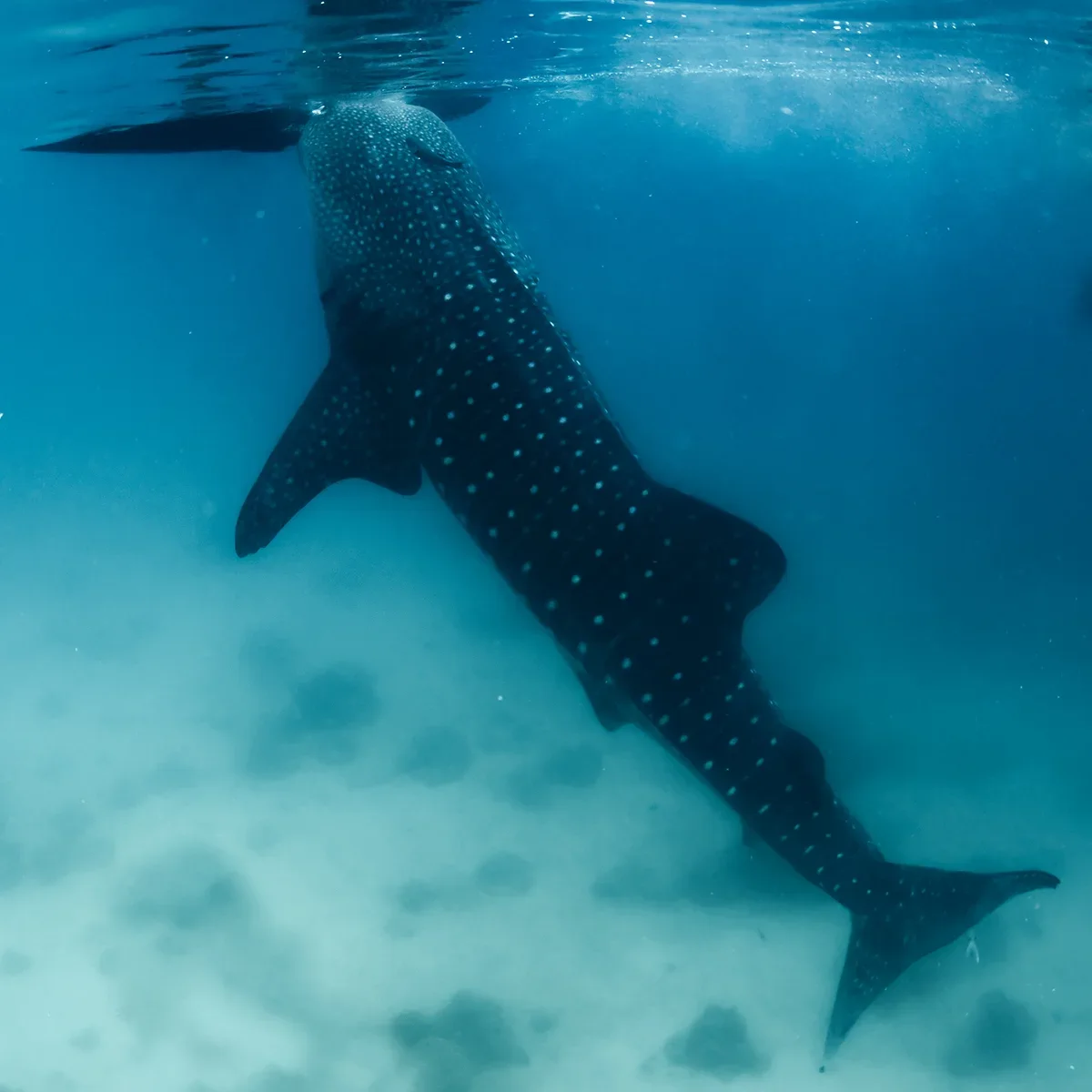
Are whale sharks guaranteed in Cenderawasih Bay? The honest answer is no — no wild-animal encounter anywhere on earth is truly 100% guaranteed, and you should be wary of any operator that promises otherwise. What is true, as of 2026, is that Kwatisore in Cenderawasih Bay delivers the most consistent whale shark encounters in Indonesia: sightings around its bagan fishing platforms run near-daily for most of the year, and travelers who book multiple bagan mornings almost always get in the water with the sharks at least once. This guide explains exactly why the odds are so high, why they still never reach 100%, and how the month you travel and the length of your trip change your real chances.
Are Whale Sharks Guaranteed in Cenderawasih Bay — or Just Very Likely?
The distinction matters. “Guaranteed” implies a contractual certainty that no honest operator in Teluk Cenderawasih will put in writing, because whale sharks are wild animals that move where the food is. “Very likely” is the accurate description — and in Cenderawasih Bay, “very likely” means something stronger than it does almost anywhere else whale sharks are watched.
Most famous whale shark destinations are seasonal migration stops: the sharks pass through for a few months, and outside that window your odds collapse to near zero. Cenderawasih Bay is different. The sharks here are not migrating through — a population of mostly juvenile males has learned to visit the bay’s bagans (traditional lift-net fishing platforms) to feed, and that behavior repeats day after day, month after month. That is why the question “are whale sharks guaranteed in Cenderawasih Bay” gets asked at all: nowhere else in Indonesia comes this close to a yes.
Why Do Encounters Happen Almost Every Day at Kwatisore?
Teluk Cenderawasih National Park is Indonesia’s largest marine national park, covering roughly 1.4 million hectares of sheltered water in the Papua region. In the Kwatisore area, near Nabire, local fishermen operate bagans — floating platforms that lower large nets overnight to catch small baitfish. Since the early 2010s, whale sharks have learned to gather beneath these platforms and suck baitfish through and around the nets. Fishermen traditionally regard the sharks as good luck and often share part of the catch.
Three things make this setup unusually reliable:
- A returning population, not passing visitors. Photo-identification research in the bay has catalogued well over a hundred individual whale sharks over the past decade, and many individuals are re-sighted repeatedly across years. These are effectively resident animals with a learned feeding routine.
- A predictable location. The bagans anchor in a known zone off Kwatisore. Guides do not have to search open ocean — they check which platforms had a catch overnight and head straight there before dawn.
- A sheltered bay. Cenderawasih Bay is protected from the large swells that shut down marine activity elsewhere in Indonesia, which is why the encounter operates in some form nearly year-round rather than in a narrow season.
This is the engine behind the near-daily sighting pattern — and also the reason it is not a guarantee. The whole system depends on baitfish, bagans, and shark behavior lining up on your particular morning.
What Do Real Success Rates Actually Look Like?
Here is the honest state of the data as of 2026: there is no independent, audited, published success-rate statistic for Kwatisore. What exists are operator and guide logs, park-adjacent research observations, and years of trip reports. Those sources agree on a consistent picture:
- On a typical bagan morning in the Kwatisore area, guides find at least one whale shark far more often than not — blank mornings are the exception, not the rule.
- Multi-day trips that include three or more bagan sessions almost never end without a single encounter. When guests miss out entirely, it is nearly always on compressed one-morning attempts.
- Numbers vary morning to morning: one shark on a quiet day, four to six or more when several animals rotate between platforms after a strong baitfish catch.
Any website quoting a precise figure like “98% guaranteed” is quoting marketing, not a dataset. The defensible claim is simpler: sightings are near-daily, and trip structure — not luck — is the main thing that separates guests who see sharks from the rare guests who do not.
Which Months Give the Best Odds?
Whale sharks are recorded in Cenderawasih Bay in every month of the year — that is the bay’s signature advantage. What changes through the year is access: sea state on the crossing, flight logistics via Nabire, and when liveaboards actually schedule the route, since most boats visit the bay only during part of the year and spend the rest of their season elsewhere in Indonesia.
| Months | Whale shark presence | Practical notes for your odds |
|---|---|---|
| January – March | Present; sightings continue | Quietest period for visiting boats. Land-based trips from Nabire operate; fewer liveaboard departures, so date choice is limited. Occasional rain does not stop bagan mornings. |
| April – June | Present; consistent bagan activity | Conditions in the sheltered bay are generally calm. A good window for land-based packages and early-season liveaboard crossings. |
| July – September | Present; peak visitor season | Most liveaboards schedule Cenderawasih in this window, so you get the widest choice of boats and the most bagan sessions per itinerary. Book early — cabins sell out. |
| October – December | Present; sightings continue | Late-season liveaboard departures taper off; land-based trips remain fully viable. Often excellent visibility and fewer guests per bagan. |
The practical takeaway: month matters less for the sharks and more for how you reach them. If your dates fall outside the main liveaboard window, a land-based itinerary staged through Nabire — flying in via Jakarta or Makassar, then roughly a three-hour boat transfer to the Kwatisore area — keeps the encounter fully on the table. Our Kwatisore whale shark trips desk runs both formats year-round.
How Trip Length Changes Your Odds
This is the single most important lever you control. Treat the following as arithmetic for illustration, not a promised statistic: if a single bagan morning succeeds most of the time but not always, then stacking independent mornings compounds strongly in your favor. One morning leaves a real chance of missing out; two mornings shrink it sharply; three or more mornings make a completely blank trip genuinely rare. That is exactly what guide logs reflect.
In practice, the formats rank like this:
- Single-morning day trips — possible from Nabire, but this is the only format where “we didn’t see one” happens with any regularity. Only choose it if your schedule allows a second attempt the next day.
- Land-based packages of 3–4 nights — two to three bagan mornings plus reef time. The sweet spot for travelers who cannot commit to a liveaboard.
- Liveaboard itineraries of 5–10 nights — multiple bagan sessions woven around the bay’s reefs and WWII-era wrecks, sleeping close to Kwatisore so you are in the water at first light. A Cenderawasih Bay whale shark liveaboard is the closest thing to a yes that the question “are whale sharks guaranteed in Cenderawasih Bay” can honestly receive.
What Can Cause a Blank Morning?
Understanding the failure modes explains why serious operators refuse to say “guaranteed”:
- No overnight catch. If the bagans caught little baitfish, there is nothing drawing sharks to the platforms at dawn.
- Bagan repositioning. Platforms move with the baitfish. Occasionally the active bagans shift beyond comfortable reach of a short trip.
- Sharks following bait schools elsewhere. Even resident animals take days off from the platforms when natural feeding is better in another part of the bay.
- Sharks present but deep. Some mornings animals hold below comfortable snorkel depth and only divers get a clear encounter.
- Weather and logistics. Rare in this sheltered bay, but heavy squalls, flight delays into Nabire, or permit timing can cost you a session — another reason buffer mornings matter.
How to Push Your Odds as Close to Guaranteed as It Gets
- Book at least three bagan mornings. This is the rule that does most of the work.
- Use a desk that coordinates with bagan crews the night before, so your boat heads to a platform with a confirmed catch instead of checking platforms at random.
- Be in the water at first light. Feeding activity is strongest in the early morning before the catch is hauled.
- Follow the interaction rules. Keeping the mandated distance and never touching or blocking the sharks keeps them relaxed — and relaxed sharks stay longer. See our guide to how to swim with whale sharks in Cenderawasih Bay for the full protocol.
- Leave a buffer day in Nabire if you are on a short land-based itinerary, so weather or flight delays cannot erase your only attempt.
The Bottom Line
So, are whale sharks guaranteed in Cenderawasih Bay? No — and any trip desk that tells you otherwise is overselling. But per 2026 field experience, Kwatisore’s bagan encounter is as close to certain as wild whale shark watching gets anywhere: a returning, photo-identified population, a known location, near-daily sightings, and odds that compound rapidly with every extra morning you book. Structure the trip correctly and the realistic risk is not missing the sharks — it is not budgeting enough days to enjoy everything else in Indonesia’s largest marine national park.
Our trip desk — part of Juara Holding Group, operating from Bali across Indonesia since 2015 — plans Cenderawasih itineraries around exactly this logic: the right month for your access mode, the right number of bagan mornings, and honest expectations at every step. Message us on WhatsApp at +62 811-3941-4563 or email [email protected], and we will map your dates against real bagan-morning availability with current indicative rates (final pricing depends on season, vessel, and group size).