
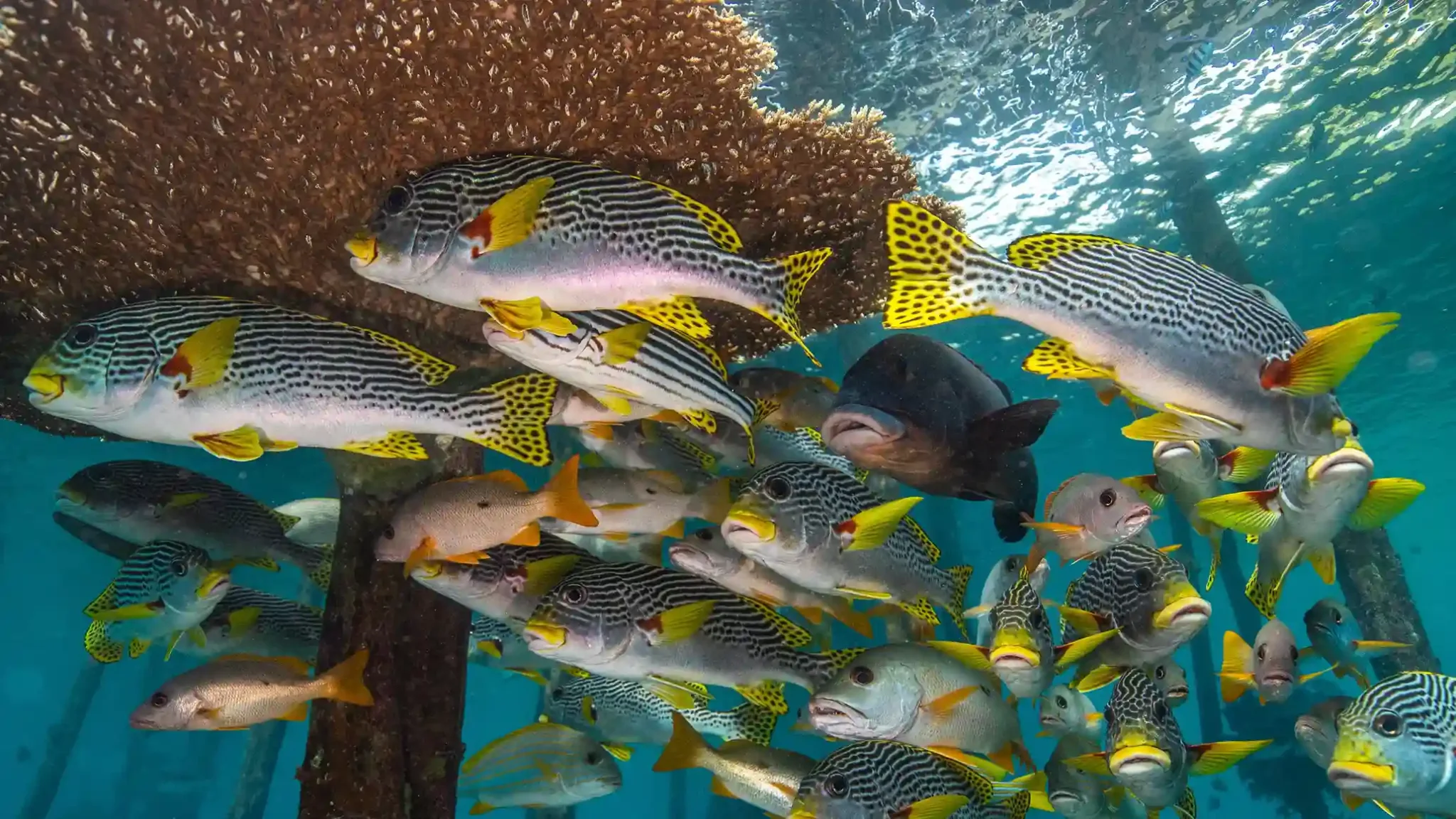
If you are asking what marine life can you see in Cenderawasih Bay, here is the short answer: whale sharks nearly year-round at the Kwatisore fishing platforms, more than a dozen reef fish species that exist nowhere else on Earth, green and hawksbill turtles, dugongs grazing the seagrass shallows, and an endemic walking shark that patrols the reef after dark. Teluk Cenderawasih is Indonesia’s largest marine national park — roughly 1.45 million hectares of protected water off West Papua — and its long geological isolation turned it into a natural species factory. This guide maps each animal to the habitat and season where you will actually encounter it, so you can plan around the sightings that matter most.
What Marine Life Can You See in Cenderawasih Bay?
Five encounters define the bay, and each happens in a different habitat:
- Whale sharks — the headline act, gathering under bagan lift-net platforms at Kwatisore in numbers and reliability that few places on the planet can match.
- Endemic reef fish — fairy wrasses, flasher wrasses, a long-nosed butterflyfish, and a dottyback described from these reefs and recorded nowhere else.
- Sea turtles — green and hawksbill turtles on the fringing reefs, with other species recorded in park waters.
- Dugongs — shy seagrass grazers in the sheltered coastal shallows, a genuine bonus sighting.
- A walking shark — an epaulette shark endemic to the bay that “walks” across the shallows on its fins during night dives.
Add healthy hard-coral gardens, dolphins on almost every crossing, and WWII-era wrecks near Manokwari, and you have a destination that rewards a full week. Our Cenderawasih Bay dive trips are built around exactly this habitat-by-habitat logic.
Why Does Cenderawasih Bay Have Species Found Nowhere Else?
The trip-planner version of the science: during past ice ages, falling sea levels and the shape of the surrounding land partially sealed Cenderawasih off from the open Pacific. Marine populations trapped inside the bay evolved separately for long enough to become distinct species. Expeditions surveying the bay in the 2000s described a string of fish found only here — which is why biologists treat Cenderawasih as a distinct pocket of the Bird’s Head Seascape rather than a copy of Raja Ampat.
The practical consequence: several fish you photograph here cannot be photographed anywhere else on Earth — the reason underwater photographers put this bay on their life list.
Whale Sharks at the Kwatisore Bagans
Kwatisore, a bay near Nabire in the park’s south, hosts the encounter Cenderawasih is famous for. Local fishermen operate bagans — floating lift-net platforms — targeting small baitfish, and whale sharks visit the platforms to suck at the nets and hoover up spilled fish. It is a natural feeding aggregation, not a staged one: the sharks were coming for the bagans long before tourism arrived.
Three things make this aggregation unusual:
- It is nearly year-round. Unlike seasonal whale shark sites elsewhere, sightings at Kwatisore are recorded in almost every month. Odds on any given morning are genuinely high, though no honest operator calls a wild animal guaranteed.
- The encounters are long. Sharks often stay around a productive bagan for hours, so you snorkel or dive with them at leisure instead of chasing a single fly-by.
- The population is well documented. Photo-identification work by researchers has catalogued well over a hundred individual sharks here, most of them juvenile males in the three-to-eight-metre range.
Interactions follow clear rules as of 2026: keep a couple of metres from the animal, never touch or ride, and follow your guide’s positioning around the nets. Both snorkellers and divers do well here — the action is in the top ten metres. If this is your priority, start with our swim with whale sharks program, which is built entirely around the Kwatisore platforms.
Reef Life: Endemic Wrasses, Damselfish, and Butterflyfish
The bay’s fringing reefs and coral gardens between roughly five and twenty-five metres are where the endemism story becomes visible. Species to brief your guide on before you drop in:
- Cenderawasih fairy wrasse (Cirrhilabrus cenderawasih) — a flame-coloured wrasse that displays over rubble slopes in the late afternoon.
- Walton’s flasherwrasse (Paracheilinus walton) — males “flash” electric fin displays at dusk; a favourite of long-lens photographers.
- Cenderawasih long-nosed butterflyfish (Forcipiger wanai) — a dark-bodied twist on a familiar Indo-Pacific shape, found on current-swept reef edges.
- Caitlin’s dottyback (Pictichromis caitlinae) — a small purple-and-yellow reef fish described from these reefs, common once you know to look.
- Several endemic damselfish — undramatic to non-specialists, but proof you are diving in a closed evolutionary pocket.
The hard corals themselves deserve mention: large, old colonies in shallow water, with some reef areas notable for their resilience. Snorkellers see plenty here — this is not a divers-only destination.
Turtles, Dugongs, and the Seagrass Shallows
Green and hawksbill turtles are the everyday sightings — expect them on reef crests and around the islands on most days of a week-long trip; other turtle species are recorded in park waters but not worth planning around.
Dugongs are the bay’s quiet treasure. They graze seagrass meadows in sheltered shallows, usually early in the morning, and sightings come down to luck plus local knowledge — crews who work this coast know which bays have active feeding trails. Treat a dugong as a bonus, not a promise; any operator who guarantees one is telling you what you want to hear.
Walking Sharks and the Night Shift
Cenderawasih has its own species of epaulette shark — a small, harmless “walking shark” described from the bay that pushes itself across shallow reef and rubble on its pectoral fins after dark. Night dives and even torchlit snorkels over the reef flat are the way to find it, along with the usual Indo-Pacific night cast of crustaceans, sleeping parrotfish, and hunting moray eels. If a walking shark is on your wish list, say so when planning — scheduling two night dives instead of none changes your odds completely.
Where and When: The Quick-Reference Table
This table is the one-page answer to what marine life can you see in Cenderawasih Bay, organised the way you will actually experience it — by habitat.
| Species / group | Habitat | Where in the bay | Best time | How you see it |
|---|---|---|---|---|
| Whale sharks | Bagan fishing platforms | Kwatisore, near Nabire | Nearly year-round; calm mornings | Snorkel or dive from a tender |
| Endemic wrasses and dottyback | Coral gardens, rubble slopes, 5–25 m | Fringing reefs across the park | Year-round; dusk for flasher displays | Diving; some visible snorkelling |
| Green and hawksbill turtles | Reef crests, island fringes | Throughout the park | Year-round | Snorkelling and diving |
| Dugong | Seagrass meadows | Sheltered coastal shallows | Early morning; luck-dependent | Surface watching, quiet snorkel |
| Walking shark (epaulette) | Shallow reef flats and rubble | Night dive sites parkwide | Year-round, after dark | Night dive or torchlit snorkel |
| Wreck fish life | WWII wrecks | Manokwari area | Trip start or end | Diving |
| Dolphins | Open water | Channels and crossings | Any crossing day | From the boat |
How Do You Actually Get to See All This?
Part of the answer to what marine life can you see in Cenderawasih Bay depends on which gateway you choose. Access runs through two towns. Nabire, in the south, is the door to Kwatisore and the whale sharks — you fly in via a domestic connection, then travel by boat to the bagan area. Manokwari, in the northwest, is the historic gateway and the base for the WWII wrecks. There is no direct international flight to either; per 2026 schedules you connect through major Indonesian hubs, and flights are worth booking early.
Trip format decides how much of the species list you can cover:
- Land-based Nabire packages concentrate on the whale sharks with day boats — the efficient choice if the sharks are 90 percent of your reason for coming.
- Liveaboard itineraries cover the full habitat spread — bagans, endemic reefs, night dives, seagrass bays — in one continuous route. Liveaboard departures are seasonal, clustering roughly from May to October when boats reposition into the bay, so dates need planning further ahead.
A multi-day Cenderawasih Bay dive safari is the format we recommend for anyone who wants the endemics and the walking shark alongside the whale sharks, because those sightings depend on reef time and night dives that day-trip schedules rarely include. Park entry permits are required for all visitors and are arranged as part of a properly organised trip.
Plan Your Cenderawasih Wildlife Trip
Knowing what marine life you can see in Cenderawasih Bay is the easy half; matching flights, seasonal boat schedules, and the right mix of bagan mornings and reef days is where trips succeed or fail. Our trip desk — part of Juara Holding Group, operating from Bali across Indonesia since 2015 — plans Cenderawasih itineraries around the specific sightings you care about, whether that is a three-day whale shark run from Nabire or a full liveaboard week chasing endemics.
Tell us your dates and your wish list on WhatsApp at +62 811-3941-4563 or email [email protected], and we will come back with a realistic route, honest odds for each species, and current availability.