
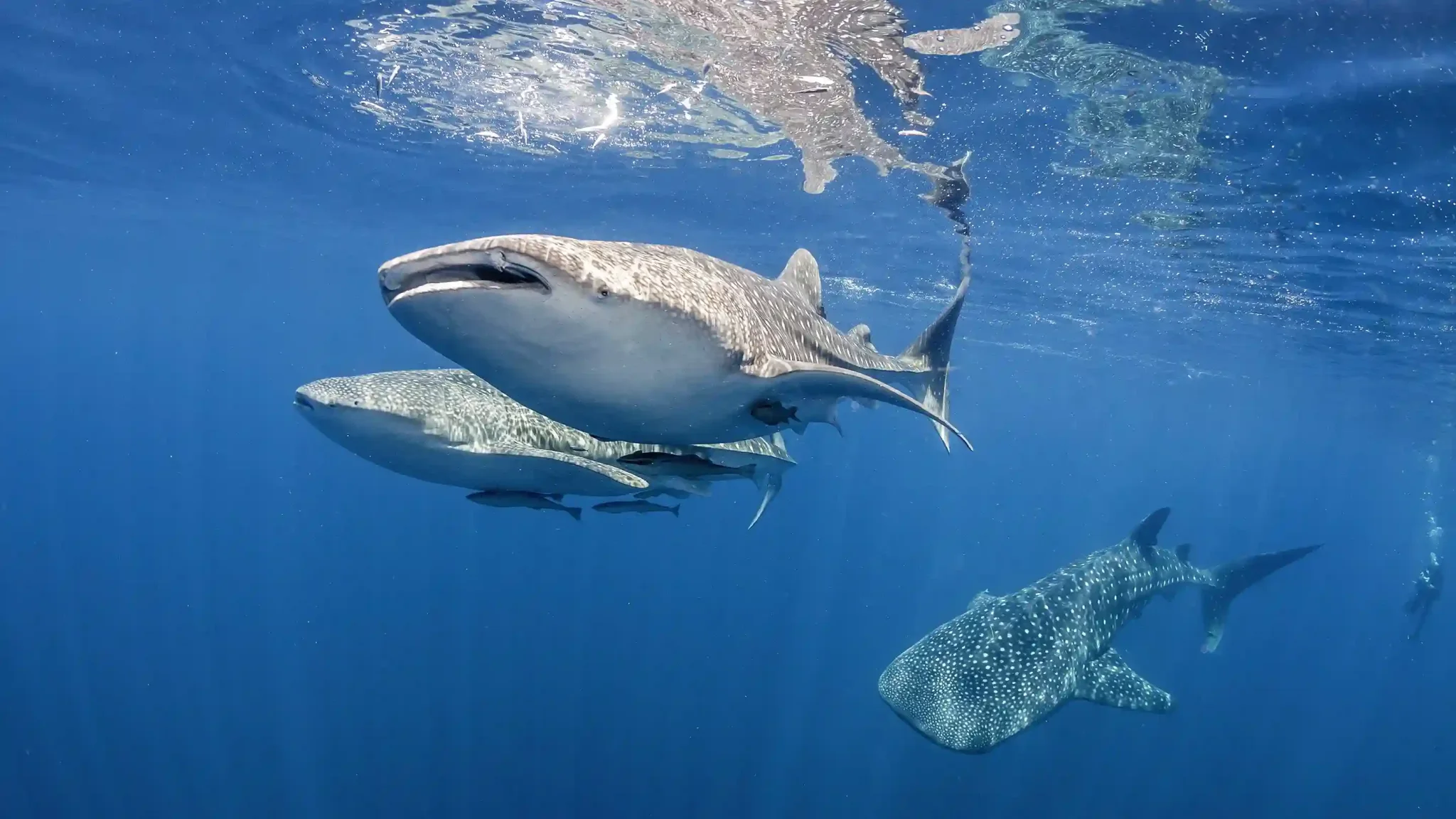
There is no single official census of whale sharks in Teluk Cenderawasih, and any source that quotes one exact number is oversimplifying. The research-backed answer to how many whale sharks in Cenderawasih Bay, as of 2026, looks like this: photo-identification surveys have catalogued well over 130 individual whale sharks since systematic monitoring began in 2011, the aggregation is present essentially year-round, and on a typical morning at the Kwatisore bagans you can expect to share the water with roughly two to eight sharks at once. This guide explains where those numbers come from, what satellite tagging has revealed about residency, and why the population structure here produces some of the most reliable whale shark encounters anywhere on Earth.
Why Is There No Single Official Count?
Whale sharks (Rhincodon typus) are wide-ranging, long-lived filter feeders, and Cenderawasih Bay is an open system, not an aquarium. The bay sits inside Teluk Cenderawasih National Park — Indonesia’s largest marine national park at roughly 1.45 million hectares, gazetted in 2002 — spanning the provinces of West Papua and Central Papua. Sharks move between the aggregation site, the wider bay, and occasionally the open Pacific, so a fixed headcount is scientifically impossible.
What researchers maintain instead is an identification catalog: a running register of every individual shark that has been photographed and matched at least once. That catalog answers a different, more useful question — not “how many sharks exist” but “how many known individuals use this bay.” For an aggregation site, the catalog number is the honest metric, and it is the figure serious operators and scientists quote.
How Many Whale Sharks in Cenderawasih Bay? What the Photo-ID Catalog Says
Systematic photo-identification in Cenderawasih began around 2011, led by Conservation International researchers working with the Teluk Cenderawasih National Park authority and local partners in Kwatisore. Within the first five years of monitoring, surveys had catalogued more than 130 individual whale sharks — a remarkable density for a single aggregation site, and one of the reasons Cenderawasih became a priority site for whale shark science in the Coral Triangle.
The catalog has continued to grow since then as new juveniles recruit into the aggregation each year, though no complete bay-wide census exists as of 2026. Just as telling as the total is the resighting record: individual sharks first photographed in the early 2010s have been re-identified many years later at the same bagans. In most whale shark hotspots — Ningaloo, Isla Mujeres, Donsol — sharks pass through seasonally. In Cenderawasih, a meaningful share of the catalog behaves like residents. So when researchers answer how many whale sharks in Cenderawasih Bay, they are describing a known, monitored community rather than a rotating cast of strangers.
How Do Scientists Identify Individual Sharks?
Every whale shark carries a unique constellation of white spots, as individual as a fingerprint. Researchers photograph a standard reference area — the flank behind the gill slits, above the pectoral fin — and run the image through pattern-matching software originally adapted from algorithms astronomers use to map star fields. Matches are logged in global libraries such as Sharkbook, which links Cenderawasih sightings to the worldwide whale shark database.
This is also where visitors become useful. A clean left-flank ID shot taken by a guest can confirm a resighting or add a new individual to the catalog, which is one reason underwater photographers get so much out of this destination. If you want to shoot deliberately — proper ID angles, split-shots at the bagans, natural-light technique in green nutrient-rich water — our Cenderawasih Bay photography expedition is built around exactly that kind of contribution-grade shooting.
What Have Satellite Tagging Studies Revealed?
Photo-ID tells you who is present; tagging tells you where they go when you are not looking. From the mid-2010s, Conservation International and the national park authority fitted a number of Cenderawasih whale sharks with fin-mounted satellite tags, producing multi-month and multi-year movement tracks.
Two findings stand out. First, residency: many tagged sharks stayed within the bay for most or all of their tracking period, and even individuals that made excursions into open Pacific waters tended to return. This confirmed what the resighting data suggested — Cenderawasih hosts one of the most site-faithful whale shark aggregations known to science. Second, depth: tagged sharks were recorded making dives well beyond 1,000 metres between visits to the surface, a reminder that the animals idling under a bagan at dawn spend part of their lives in the deep ocean. As of 2026, this combination of shallow habituated surface behaviour and extreme diving remains an active research topic.
Why Are Almost All of Them Juvenile Males?
Surveys in Cenderawasih consistently report a heavily male-dominated aggregation — figures around nine in ten identified sharks are typical of the published work — with most individuals measuring roughly three to seven metres, which for a species that matures at around eight to nine metres means juveniles and sub-adults. This mirrors coastal whale shark aggregations worldwide: young males gather where food is dense and predictable, while adult females remain largely offshore and are rarely seen anywhere.
In Cenderawasih, the predictable food source is the bagan — the lift-net fishing platform anchored off Kwatisore. Bagan crews target silverside baitfish, and whale sharks learned generations ago to sip spilled fish through the nets. Local fishermen traditionally regard the animals, known here as gurano bintang (“star shark”), as bearers of good fortune rather than pests, a cultural detail that underpins the whole ecosystem of respectful encounters. The juvenile-male pattern matters for visitors too: young sharks are curious, tolerant, and behaviourally consistent, which is precisely what makes in-water encounters here so calm and close.
What Does the Population Data Mean for Your Encounter?
The practical version of how many whale sharks in Cenderawasih Bay is the morning count at the bagans: most days deliver two to eight sharks around the platforms, occasionally more, with sightings recorded in every month of the year. Because the sharks are resident and habituated rather than migratory and skittish, encounter reliability here is exceptional — this is one of very few places on the planet where a multi-day trip effectively removes luck from the equation, even though no ethical operator will ever use the word “guaranteed” for a wild animal.
Population structure shapes the experience itself. Resident juveniles hold position near the surface for extended periods, so this is a snorkel-first destination where long, unhurried in-water sessions are the norm — see our swim with whale sharks program for how interactions are run under national park rules. Divers and photographers who want repeated sessions across several days, plus the reef and wreck sites deeper in the park, typically choose a Cenderawasih Bay whale shark liveaboard, which positions you at the bagans at first light when shark numbers peak.
Cenderawasih Bay Whale Shark Numbers at a Glance
Key figures for quick reference, current as of 2026:
| Metric | Figure |
|---|---|
| Marine park area | ±1.45 million hectares — Indonesia’s largest marine national park (est. 2002) |
| Systematic monitoring since | 2011 (photo-ID), satellite tagging from the mid-2010s |
| Photo-identified individuals | 130+ within the first five years; catalog still growing, no full census |
| Typical sharks per morning at the bagans | 2–8, occasionally more |
| Sex ratio in published surveys | Strongly male-dominated (~9 in 10) |
| Dominant size class | 3–7 m juveniles and sub-adults |
| Seasonality | Present year-round; sightings recorded in every month |
| IUCN status | Endangered (assessed 2016) |
Plan a Trip Built Around the Science
Understanding the population is what separates a good Cenderawasih trip from a great one: timing your mornings for the bagans, choosing snorkel versus dive sessions, and knowing that the shark beside you may be an individual researchers have tracked for a decade. Our desk plans whale shark itineraries end to end — Nabire land-based stays, liveaboard routings, and photography-focused departures — with realistic expectations grounded in the encounter data above. Part of Juara Holding Group, operating from Bali across Indonesia since 2015.
Tell us your dates and how you want to meet the gurano bintang, and we will map the options. Message us on WhatsApp at +62 811-3941-4563 or email [email protected] for a same-day reply.